


Understanding ABS, Not long ago, Anti-Lock Braking Systems were seen as something extra. A feature you noticed on a specification sheet, not something you thought about during daily driving. That thinking has changed. Today’s traffic, tighter roads, sudden braking, and unpredictable surfaces have made ABS less of a luxury and more of a necessity.
Whether it is a private car, a delivery vehicle, or a fully loaded commercial truck, braking safely now depends as much on control as it does on stopping distance. ABS exists to protect that control.
For vehicle owners, workshops, and fleet operators sourcing parts from Right Auto Spares, understanding ABS is not about theory. It is about making smarter maintenance choices and avoiding failures when braking matters most.
What ABS Actually Does
When brakes are applied suddenly, an Anti-Lock Braking System prevents the wheels from locking up. Once a wheel stops rotating, the tyre loses grip, and the vehicle begins to slide instead of slowing down. In that moment, steering becomes almost useless, which is why locked wheels often result in accidents.
ABS is not designed to make braking stronger. Its purpose is to make braking more controlled.
Rather than allowing pressure to increase until the wheels stop turning, the system eases and reapplies pressure in quick cycles. This keeps the tyres moving just enough to maintain contact with the road. Because the wheels continue to roll, the driver can still steer while braking, even on slippery or uneven surfaces.
Why ABS Matters Outside Perfect Conditions
Most braking tests assume clean, dry roads. Real roads are different.
Loose dust near construction zones, water during monsoons, oil patches at traffic signals, uneven highways, and worn tyres all reduce grip without warning. In these moments, instinctive hard braking can easily push wheels into lock-up.
ABS reduces that risk by reacting faster than any human driver could. It steps in during panic braking, heavy loads, or sudden obstacles, especially at higher speeds.
For commercial vehicles, the stakes are even higher. Added weight changes braking behaviour completely. ABS helps maintain stability, protects tyres, and supports safety compliance, which is why it is now standard in many fleet and trailer applications.
How ABS Works in Real Terms
In the past, drivers were told to press and release the brakes during a skid. ABS now does this on its own, much faster than a person ever could.
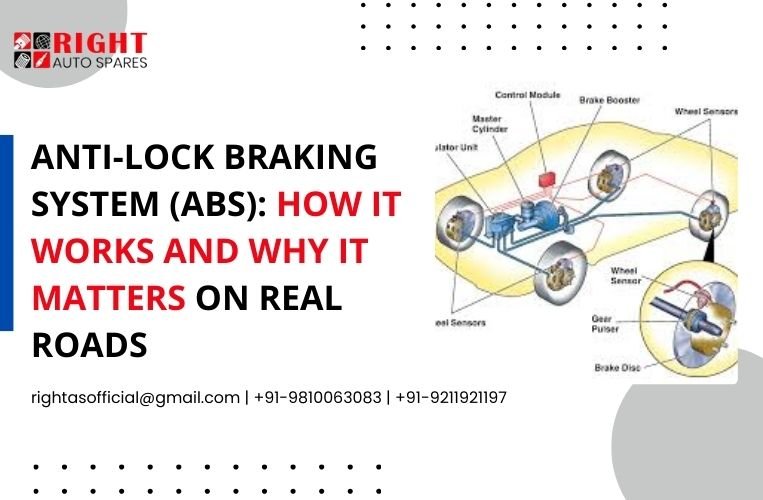
Each wheel has a small sensor that checks how it is moving. If a wheel starts to stop too suddenly, the system slightly loosens the brake and then presses it again once grip comes back. This happens many times in a second until the vehicle slows down safely.
If the brake pedal shakes or pushes back under your foot, that is normal. It means the system is working to stop the wheels from locking. It is not a fault. It is the system doing its job.
Key Parts Inside an ABS Setup
ABS relies on accuracy. Even one weak component can affect the entire system.
Wheel speed sensors track rotation at each wheel and provide real-time input. The electronic control unit processes this information and decides when intervention is needed. The hydraulic unit adjusts brake fluid pressure using valves and pumps.
Because everything happens in milliseconds, component quality matters. Delayed signals or inconsistent pressure control can reduce effectiveness or trigger warning lights.
Different ABS Configurations
Not all ABS systems are built the same.
Most modern passenger vehicles use four sensors and four control channels, allowing individual control at each wheel. Some pickups and older designs use three-channel systems, where the front wheels are controlled independently but the rear wheels share control.
Basic or older systems may rely on a single sensor, usually at the rear axle. These setups give only basic support and are rarely seen on newer vehicles.
Modern systems go a step further. Technologies such as Electronic Stability Control use ABS data along with steering movement and vehicle direction to step in when control starts to slip. In tense moments, they can slow individual wheels to help the vehicle stay on course.
ABS in Commercial Vehicles and Trailers
In heavy vehicles, braking mistakes carry bigger consequences.
Trailers and loaded trucks are more prone to wheel lock-up, especially during sudden stops or downhill braking.
ABS helps prevent tyre skidding, reduces stress on braking components, and improves directional stability.
Well-maintained ABS systems also reduce uneven tyre wear and help fleets meet safety and insurance requirements.
Warning Signs That Should Not Be Ignored
ABS issues rarely fail silently. Most problems announce themselves through dashboard warning lights.
Common causes include damaged wheel sensors, broken wiring near hubs, or faults in the hydraulic unit. In dusty or wet conditions, sensor contamination is also common.
When the ABS light stays on, normal braking still works, but the anti-lock function is disabled. Many drivers ignore this because the vehicle still stops. The real risk appears during emergency braking, when ABS is needed the most.
Why Spare Part Quality Makes a Difference
ABS systems do not tolerate inconsistency. Poor-quality sensors can send inaccurate signals. Low-grade hydraulic components may respond slowly or fail under pressure.
This is why workshops and vehicle owners rely on suppliers like Right Auto Spares for dependable ABS components. Quality parts ensure proper sensor readings, consistent brake pressure control, and fewer repeat failures.
Saving money on critical braking parts often leads to higher costs later, both in repairs and risk.
Keeping ABS Reliable Over Time
ABS does not need daily attention, but it should never be treated as maintenance-free.
Warning lights should be addressed early. Sensor areas should be kept clean during brake servicing. Brake fluid quality matters more than many drivers realise. Most importantly, replacement parts should match system specifications.
Preventive care ensures the system responds correctly when sudden braking leaves no room for error.
Final Thoughts
ABS is something most drivers forget about, right up to the second it steps in. There is no noise, no warning, just the car responding the way it should when the road suddenly turns unpredictable.
Knowing how it works makes it easier for vehicle owners and fleet operators to take the right calls on upkeep and parts. With dependable components from suppliers like Right Auto Spares, ABS continues to do its job quietly, maintaining control when it counts more than speed.
On real roads, safety is not about stopping fastest. It is about stopping without losing control. ABS exists for exactly that reason.