
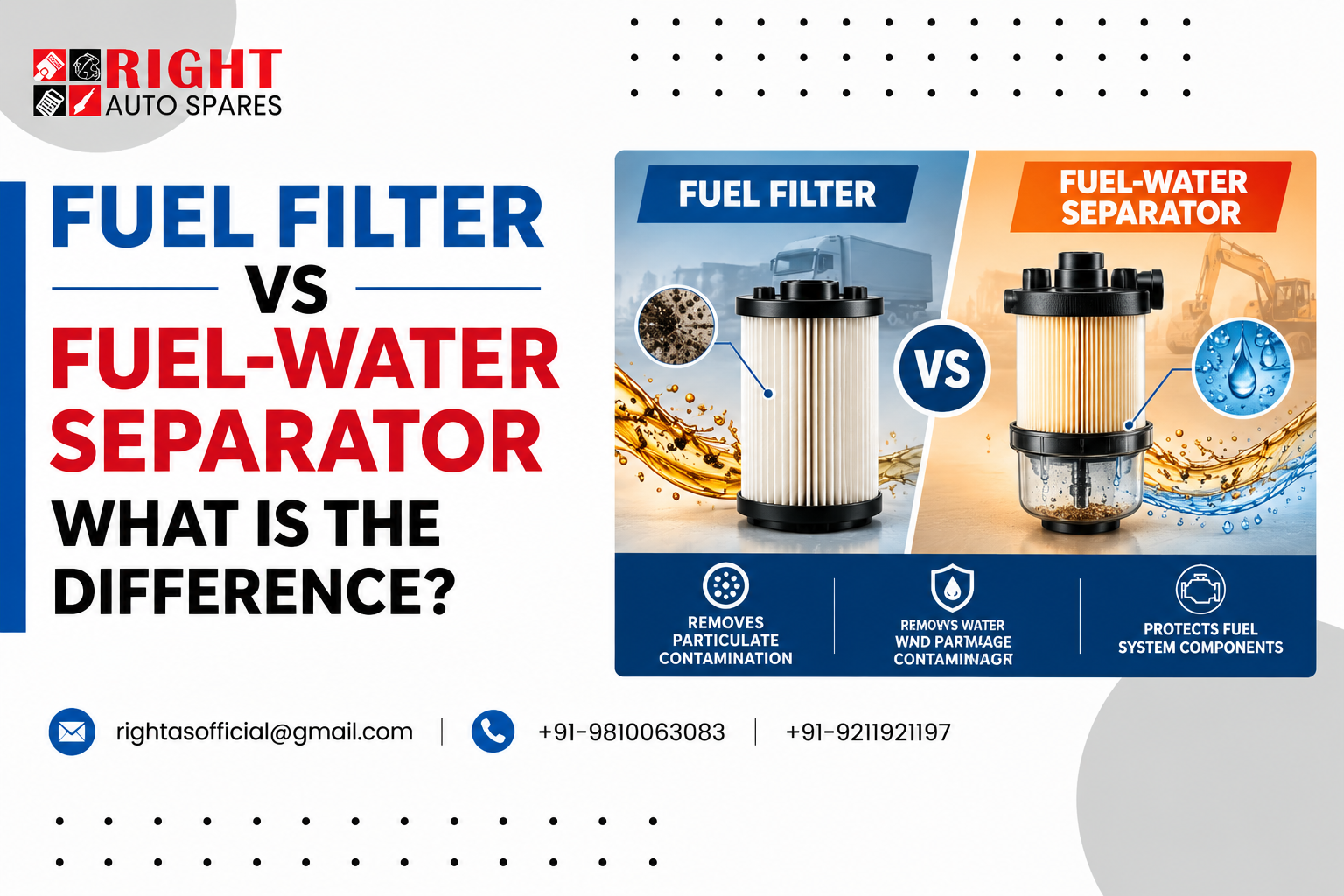


A fuel filter removes solid contaminants from fuel, while a fuel-water separator is designed to remove water as well as particulate contamination. The two are closely related, but they are not always interchangeable.
For truck owners, fleet operators, workshops, construction companies, agricultural equipment users, and diesel generator operators, knowing the difference can prevent the wrong replacement filter from being installed. The correct component depends on the engine, fuel-system design, filter position, required filtration performance, and whether water separation is part of the system's specifications.
At Right Auto Spares, fuel filtration is an important part of the automotive and industrial spare-parts range. The company supplies filters for automotive, commercial vehicle, construction, agricultural, mining, material-handling, and power-generation applications. That makes understanding the difference between a conventional fuel filter and a fuel-water separator particularly useful when sourcing replacement parts.
Fuel Filter vs Fuel-Water Separator at a Glance
| Feature | Fuel Filter | Fuel-Water Separator |
|---|---|---|
| Primary purpose | Removes particulate contamination | Removes water and particulate contamination |
| Typical contaminants | Dirt, dust, rust, sediment | Water, dirt, rust, sediment |
| Water separation | Depends on design | Specifically designed for water separation |
| Common application | Diesel and petrol fuel systems | Mainly diesel and other water-sensitive systems |
| Drain provision | Not always included | Common on many designs |
| Water-in-fuel sensor | Application dependent | Available on some systems |
| Typical system position | Primary or secondary stage | Often primary stage |
| Main protection | Fuel pump and injection components | Fuel system against water and particles |
Key Point: A fuel-water separator is a fuel filtration component with a specific water-separation function, but not every fuel filter provides that function.
What Does a Fuel Filter Do?
A fuel filter captures unwanted solid contaminants before they travel further through the fuel system.
These contaminants can include dirt, rust, dust, sediment and particles introduced during fuel storage, transportation or handling. In diesel engines, controlling these contaminants is particularly important because modern injection equipment operates with high pressures and tight component clearances.
A diesel engine can also use multiple filtration stages. The primary stage may handle larger contamination and water, while a secondary filter provides finer particulate filtration closer to the injection system. Donaldson explains that primary and secondary fuel filters can have different filtration roles and performance requirements.
This is why replacing a filter based only on its appearance or micron number can be risky. The correct filter must match the fuel system for which it was designed.
What Is a Fuel-Water Separator?
A fuel-water separator is designed to remove water from fuel while also controlling particulate contamination.
Water can enter fuel through condensation, storage conditions, transportation, handling or contaminated fuel supplies. In diesel systems, water can contribute to corrosion, reduced fuel-system lubrication and wear of sensitive injection components.
A fuel-water separator uses a design that allows water droplets to separate from the fuel. Depending on the product, separated water may collect in a bowl or lower chamber where it can be drained. Some systems also include a water-in-fuel sensor.
For example, Fleetguard offers fuel-water separation systems designed to remove water and contaminants before fuel reaches the fuel pump. Some applications incorporate water-in-fuel sensing as part of the assembly.
The exact design varies by manufacturer and application, so the product specification matters more than the name printed on the filter.
How Does a Fuel-Water Separator Work?
The basic process involves both particulate filtration and water separation.
- Contaminated fuel enters the separator.
- Larger particles are captured by the filter element.
- Water droplets are separated from the fuel.
- Separated water collects in the lower portion of the assembly.
- Water is drained according to the equipment manufacturer's maintenance instructions.
- Cleaner fuel moves toward the next stage of the fuel system.
Some separators use coalescing technology. In these designs, smaller water droplets combine into larger droplets that can separate more easily from the fuel.
The important distinction is that water separation requires a filter designed for that purpose. A conventional particulate filter should not automatically be assumed to provide equivalent water-removal performance.
Fuel Filter vs Fuel-Water Separator: The Main Difference
The main difference is the type of contamination each component is designed to control.
A conventional fuel filter primarily focuses on particulate contamination. A fuel-water separator adds dedicated water-management capability.
This difference becomes particularly relevant for diesel-powered equipment operating in environments where fuel contamination or water ingress is a concern.
However, terminology can cause confusion. Some manufacturers refer to their primary fuel filters as fuel filter water separators because the component performs both functions. Donaldson, for example, describes primary fuel filters as components that can provide water separation as well as particulate filtration.
Therefore, do not rely on the product name alone. Check the manufacturer's technical information and the equipment's recommended part number.
Is a Fuel-Water Separator Better Than a Fuel Filter?
Not automatically.
A fuel-water separator is better when water separation is a required part of the fuel system. A conventional fuel filter may be the correct choice where the system requires a specific particulate filtration stage.
Many diesel fuel systems use both.
The primary stage can provide water separation and initial contaminant removal. A secondary filter can then provide finer particulate filtration before fuel reaches sensitive injection components.
This staged approach means the two components often complement each other rather than compete with each other.
For Right Auto Spares customers sourcing replacement filters, this distinction is important when checking an OEM reference or cross-reference number. A filter that fits physically may still be unsuitable if it does not provide the filtration function required at that particular position.
Why Is Water Dangerous in Diesel Fuel?
Water creates problems that ordinary dirt does not.
It can contribute to corrosion and can reduce the lubricating properties needed by fuel-system components. Modern high-pressure common-rail systems can be particularly sensitive to water contamination.
Water can also create conditions that support microbial growth in stored fuel. Microbial contamination can contribute to sludge, corrosive by-products and filter blockage.
That is why water separation is treated as a specific performance requirement rather than simply another form of particulate filtration.
For equipment working in construction, agriculture, mining, transportation, marine environments or remote sites, proper fuel filtration can be especially important because fuel quality and storage conditions may vary.
Primary vs Secondary Fuel Filters
Understanding where a filter sits in the fuel system helps explain why different filters have different specifications.
Primary Fuel Filter
The primary filter is generally positioned upstream of the fuel pump.
It can provide initial contaminant removal and, depending on the system, water separation. Because it handles the earlier filtration stage, its design must provide suitable fuel flow while removing the contaminants for which it was specified.
Many primary filters incorporate a water separator, drain valve or water-in-fuel sensor.
Secondary Fuel Filter
The secondary filter is positioned further downstream.
Its main role is often finer particulate filtration before fuel reaches the injection system. Because the filter is protecting sensitive components, its required filtration performance can differ from that of the primary filter.
This is one reason why two filters used on the same engine should not be treated as interchangeable simply because both are described as "fuel filters."
Can a Fuel Filter Remove Water?
Some fuel filters can remove water, but not every fuel filter is designed to do so.
If water separation is required, look for manufacturer information specifically identifying the product as a fuel-water separator or confirming its water-separation performance.
Features such as a drain valve, collection bowl or water-in-fuel sensor can also indicate that the assembly has a water-management function, although the presence of a particular feature should still be verified against the manufacturer's specifications.
When sourcing filters through Right Auto Spares, buyers should provide the equipment or engine model and existing part number whenever possible. This makes it easier to identify the correct filtration type rather than relying on a generic product description.
Do All Diesel Engines Need a Fuel-Water Separator?
No.
The required filtration arrangement depends on the engine and equipment manufacturer.
Some diesel engines use a dedicated fuel-water separator followed by a secondary fuel filter. Others combine water separation and particulate filtration in one assembly.
The correct approach is to follow the filtration arrangement specified for the engine.
Before ordering a replacement, check:
- Engine make and model
- Equipment model
- Existing filter part number
- OEM reference number
- Filter position
- Required filtration rating
- Water-separation requirement
- Flow requirements
- Thread and connection type
- Filter dimensions
- Seal or gasket specifications
- Drain or sensor requirements
This information is particularly useful for wholesale and commercial buyers because a small part-number error can affect an entire bulk order.
Fuel Filter vs Fuel-Water Separator for Trucks and Heavy Equipment
Heavy-duty diesel applications often place greater demands on fuel filtration.
Trucks, excavators, loaders, tractors, generators and other equipment may operate for long periods under high loads. Fuel systems must maintain adequate flow while controlling contamination.
In these applications, the filtration system may include a water-separating primary filter and a finer secondary filter.
Right Auto Spares supplies fuel filters and other filtration products for automotive and industrial applications. Its product range covers applications connected with commercial vehicles, construction, agriculture, mining, material handling and power generation.
For buyers, the best starting point is not simply asking for "a diesel fuel filter." Providing the engine model, equipment model, existing part number or OEM reference gives the supplier much more useful information for identifying the correct product.
How to Choose the Right Fuel Filter or Separator
Start with the manufacturer's recommended part number. Then compare the replacement against the technical requirements of the application.
or commercial or bulk orders, ask the supplier to verify:
- OEM or manufacturer reference
- Cross-reference number
- Engine and equipment compatibility
- Primary or secondary filter position
- Micron rating
- Filtration efficiency
- Water-separation capability
- Flow requirements
- Dimensions and connection details
- Drain or sensor compatibility
- Manufacturer documentation
- Availability and lead time
Right Auto Spares can be considered when sourcing automotive and industrial filtration products, particularly when the requirement involves commercial vehicles, heavy equipment or industrial applications. The more application information provided at the quotation stage, the easier it is to avoid an incorrect replacement.
Common Mistakes When Buying Fuel Filters
Choosing only by micron rating
A micron rating tells you something about particle filtration, but it does not describe the complete performance of a filter. Efficiency, flow, media, capacity and application requirements also matter.
Assuming every fuel filter separates water
Water separation is a specific design function. Always verify it in the manufacturer's specifications.
Ignoring filter position
Primary and secondary filters can have different requirements. A replacement intended for one stage may not be suitable for another.
Matching only by appearance
Two filters can have similar dimensions while using different threads, seals, media or filtration specifications.
Ordering without checking the part number
A correct OEM or cross-reference number is one of the simplest ways to reduce selection errors.
Forgetting water drainage
If the system uses a drainable water separator, accumulated water must be removed according to the equipment manufacturer's maintenance schedule.
Final Takeaway
A fuel filter and fuel-water separator are related, but they are not automatically interchangeable. A fuel filter focuses primarily on particulate contamination, while a fuel-water separator is specifically designed to manage water along with particles.
For trucks, generators and heavy equipment, the right choice depends on the complete fuel-system design. Check the OEM part number, filter position and technical specifications before ordering.
For buyers sourcing automotive and industrial filters from Right Auto Spares, providing accurate application and part-number information is the simplest way to narrow the selection and avoid ordering a filter that fits physically but does not perform the required job.
FAQs
1. What is the difference between a fuel filter and a fuel-water separator?
A fuel filter primarily removes particulate contaminants such as dirt, rust and sediment. A fuel-water separator is designed to remove water from fuel as well as particulate contamination.
2. Can a fuel-water separator replace a fuel filter?
Only if it meets the specifications for that particular filtration stage. A fuel-water separator should not automatically be used as a replacement for every fuel filter.
3. Is a fuel-water separator necessary for diesel engines?
Not every diesel engine uses a separate separator. Some fuel systems combine water separation and particulate filtration, while others use separate primary and secondary stages. Follow the engine manufacturer's specifications.
4. Which is better for a truck, a fuel filter or a fuel-water separator?
It depends on the truck's fuel-system design. Many diesel trucks use a water-separating primary filter along with a finer secondary fuel filter. The correct replacement should match the manufacturer's specified part number and filtration requirements.
5.How often should a fuel-water separator be drained?
The required interval varies by equipment, separator design and fuel quality. Follow the manufacturer's maintenance instructions. Equipment operating with contaminated fuel may require more frequent water removal.
6. How do I choose the correct fuel filter for heavy equipment?
Provide the equipment and engine model, existing filter number and OEM reference. Then verify filter position, filtration rating, water-separation requirements, flow, dimensions, connections and other manufacturer specifications before ordering.
<!-- Comments are visible in the HTML source only -->