
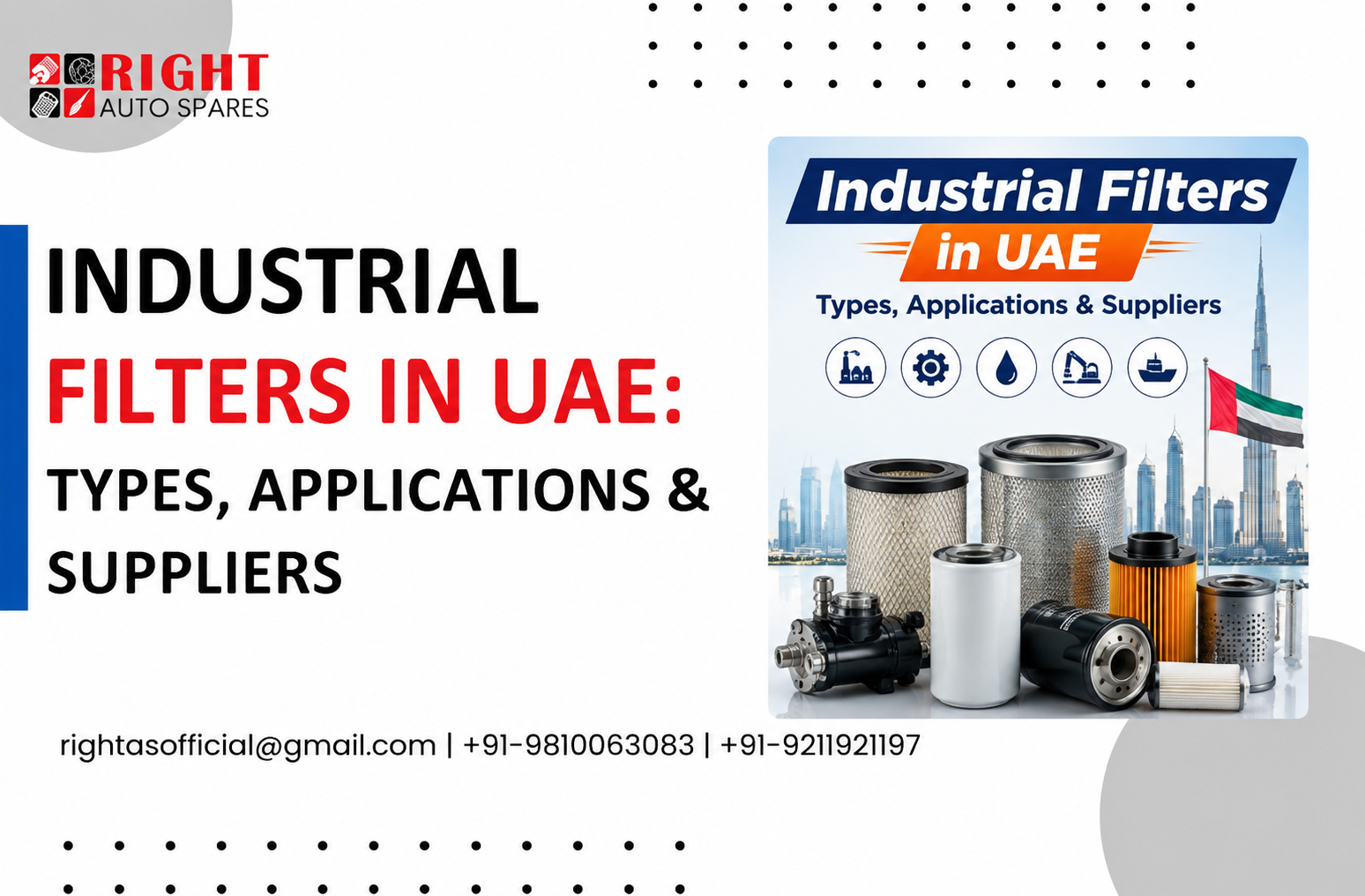

An industrial filter does a simple job, but choosing the wrong one can create expensive problems. The right filter helps keep dust, dirt, water, metal particles, sludge, and other contaminants away from engines, hydraulic systems, generators, compressors, and industrial machinery.
This matters in the UAE, where construction equipment, commercial vehicles, generators, agricultural machinery, marine equipment, and industrial systems often work in demanding environments. Dust exposure, long operating hours, heavy workloads, and high ambient temperatures all make proper filtration an important part of equipment maintenance.
But which industrial filter does your equipment actually need?
The answer depends on the system being protected, the type of contamination involved, the equipment manufacturer's specification, and the conditions in which the machine operates.
This guide covers the main types of industrial filters used in the UAE, their applications, what to check before ordering, and how to choose a supplier that can support your requirements.
What Are Industrial Filters?
Industrial filters are components designed to remove or control contaminants from air, fuel, oil, hydraulic fluid, coolant, water, or other fluids used by machinery.
The filter's job changes according to the application.
An air filter protects an engine from airborne particles. A fuel filter controls contamination entering the fuel system. A hydraulic filter helps maintain fluid cleanliness within a hydraulic circuit.
This distinction is important because there is no universal industrial filter. A filter that fits physically is not necessarily the correct filter for the application.
Why Industrial Filtration Matters in the UAE
Equipment operating in the UAE can face conditions that place additional demands on maintenance.
Construction machinery, for example, can work around dust and loose material. Heavy-duty trucks may operate for long hours. Generator sets can run continuously or serve as critical backup equipment. Agricultural and marine equipment face their own operating conditions.
Effective filtration helps control contaminants before they reach sensitive components.
- Poor or incorrect filtration can contribute to:
- Increased component wear
- Restricted airflow
- Contaminated hydraulic fluid
- Fuel-system contamination
- Higher maintenance requirements
- Reduced equipment reliability
- Unplanned downtime
The filter itself is only one part of the maintenance system. Correct installation, replacement intervals, fluid condition, and adherence to OEM recommendations also matter.
Types of Industrial Filters Used in UAE
Different systems require different types of filtration.
| Filter Type | What It Protects | Common Applications |
|---|---|---|
| Air Filter | Engine or equipment intake | Excavators, trucks, generators, compressors |
| Oil Filter | Lubrication system | Diesel engines, generators, industrial machinery |
| Fuel Filter | Fuel system | Trucks, generators, agricultural and construction equipment |
| Hydraulic Filter | Hydraulic circuit | Excavators, cranes, loaders, forklifts |
| Coolant Filter | Cooling system | Selected heavy-duty diesel applications |
| Fuel-Water Separator | Diesel fuel system | Generators, marine and heavy-duty diesel equipment |
| Air-Oil Separator | Compressed-air system | Industrial compressors |
The same machine can use several different filters, each performing a separate function.
1. Industrial Air Filters
Air filtration prevents airborne contaminants from entering an engine or equipment intake system.
This is particularly relevant for equipment operating around construction sites, unpaved areas, agricultural fields, and other environments where dust exposure is high.
Common applications include:
Excavators
Wheel loaders
Trucks
Diesel generators
Agricultural machinery
Compressors
Construction equipment
When replacing an air filter, check the equipment manufacturer's part number and specification. Dimensions alone do not establish compatibility.
2. Industrial Oil Filters
Oil filters remove contaminants from lubricating oil before it circulates through an engine or machinery system.
During operation, engine oil can collect particles and other contaminants. Effective filtration helps maintain the cleanliness of the lubrication system and protects components that depend on clean oil.
Oil filters are commonly used in:
Diesel engines
Generator sets
Heavy-duty vehicles
Construction machinery
Agricultural equipment
Industrial engines
Before ordering a replacement, verify the filter part number and application rather than relying only on its physical appearance.
3. Industrial Fuel Filters
Fuel filters help control contamination in diesel and other fuel systems. Depending on the filter design, they can address particulate contamination and, in suitable applications, water contamination.
They are commonly found in:
Diesel generators
Heavy-duty trucks
Excavators
Agricultural machinery
Construction equipment
Marine engines
Correct fuel filtration is particularly important where the fuel system contains components that are sensitive to contamination.
4. Hydraulic Filters
Hydraulic systems depend on clean fluid to operate pumps, valves, cylinders, motors, and other components.
Hydraulic filters help control particulate contamination within the hydraulic circuit.
Typical applications include:
Excavators
Cranes
Loaders
Forklifts
Hydraulic presses
Material-handling equipment
Industrial machinery
When selecting a hydraulic filter, check the requirements of the specific system. Depending on the application, relevant specifications can include filtration rating, flow requirements, pressure rating, connection type, and filter configuration.
5. Coolant Filters
Some heavy-duty diesel engines use coolant filtration as part of their cooling-system maintenance.
Coolant filters can help manage contaminants within systems designed for this type of filtration. However, coolant-filter requirements vary between engines and cooling-system designs.
Do not assume that every diesel engine requires the same coolant filter.
Follow the engine manufacturer's coolant specification and maintenance procedure when selecting and replacing coolant filtration products.
6. Fuel-Water Separators
Water contamination is an important concern in diesel fuel systems.
Fuel-water separators are designed for applications where water separation is required. They are commonly used on diesel-powered equipment such as generators, marine engines, heavy-duty vehicles, and construction machinery.
Before replacing one, verify the application, connection arrangement, capacity, and manufacturer's specifications.
Industrial Filter Applications Across UAE Industries
The filtration requirement changes according to the equipment and working environment.
| Industry | Typical Equipment | Common Filtration Requirements |
|---|---|---|
| Construction | Excavators, loaders, cranes | Air, oil, fuel, hydraulic |
| Transportation | Trucks, buses, commercial vehicles | Air, oil, fuel |
| Power Generation | Diesel generator sets | Air, oil, fuel, coolant |
| Agriculture | Tractors and agricultural machinery | Air, oil, fuel, hydraulic |
| Marine | Marine engines and equipment | Fuel, oil, air |
| Manufacturing | Industrial machinery | Hydraulic, air, oil, process filtration |
| Mining | Heavy equipment | Air, oil, fuel, hydraulic |
| Oil & Gas | Engines and industrial equipment | Application-specific filtration |
There is no single filter specification for an entire industry. The equipment and system determine what filtration is required.
How UAE Operating Conditions Affect Filter Selection
A filter should be selected according to the machine's actual working conditions.
Dust Exposure
Equipment operating at construction sites, quarries, roads, and earthmoving locations can encounter substantial airborne dust.
This makes appropriate intake-air filtration especially important.
Long Operating Hours
Equipment running for extended shifts needs a maintenance plan based on its actual duty cycle and the manufacturer's recommendations.
Heat
High ambient temperatures can place additional demands on equipment systems. The selected filter should meet the manufacturer's specified operating requirements for the application.
Working Environment
Marine equipment, construction machinery, generators, agricultural equipment, and industrial machinery encounter different types of contaminants.
This is why simply asking for a “heavy-duty filter” is often insufficient.
How to Choose the Right Industrial Filter
Before contacting a supplier, collect the equipment information.
1. Identify the Equipment
Record the:
Equipment manufacturer
Model
Engine model
Serial number where relevant
Year or application information
2. Find the Existing Part Number
The number printed on the existing filter can provide an important starting point.
Do not assume the number is correct without checking it against the equipment application.
3. Check the OEM Specification
Use the equipment or engine manufacturer's maintenance information to establish the required filter.
4. Check Technical Specifications
Depending on the filter type, consider:
Filtration rating
Dimensions
Flow requirement
Pressure rating
Connection type
Filter media or construction
Application compatibility
5. Verify Any Cross-Reference
A cross-reference can help identify an alternative filter, but it should be checked against reliable application information before the order is approved.
Why Filter Size Alone Is Not Enough
Two filters can look almost identical and still have different applications.
A correct replacement involves more than matching:
Diameter
Length
Thread
Housing size
Other specifications can affect suitability, including filtration characteristics, flow capacity, pressure requirements, sealing arrangement, and application.
This is particularly important when purchasing filters for heavy equipment or when placing a large wholesale order.
If you only compare dimensions, you can end up with a filter that fits the housing but does not meet the equipment's requirements.
OEM vs Aftermarket Industrial Filters
Industrial filter buyers often have a choice between OEM products and aftermarket alternatives.
OEM Filters
OEM filters are supplied through the original equipment manufacturer's specifications or approved channels. They are often selected when the equipment owner requires a specific manufacturer or specification.
Aftermarket Filters
Aftermarket filters are manufactured by companies other than the original equipment manufacturer.
Quality varies between manufacturers and product lines. A quality aftermarket filter should be assessed according to its application, technical specification, manufacturer, and relevant quality documentation.
The important question is not simply:
“Is it aftermarket?”
The better question is:
“Is this particular filter correctly specified for my equipment?”
What Makes a Good Industrial Filter Supplier?
The supplier should be able to help you identify the correct product rather than simply quote the cheapest available option.
Before choosing a supplier, check:
| What to Evaluate | Why It Matters |
|---|---|
| Application knowledge | Helps identify suitable products |
| Part-number support | Reduces wrong-order risk |
| Product range | Simplifies multi-category sourcing |
| Product information | Helps buyers compare specifications |
| Stock availability | Supports maintenance planning |
| Bulk supply | Useful for fleets and distributors |
| Export capability | Important for international procurement |
| Communication | Makes technical and order issues easier to resolve |
For businesses managing multiple equipment models, technical assistance can be as important as product availability.
What Information Should You Give Your Filter Supplier?
A supplier can identify the right product more efficiently when the enquiry contains complete information.
Provide:
Equipment: Manufacturer and model
Engine: Engine manufacturer and model where applicable
Part number: Existing or OEM reference
Filter type: Air, oil, fuel, hydraulic, coolant, etc.
Quantity: Required quantity
Application: Construction, generator, truck, agriculture, marine, etc.
Location: Delivery destination
Timing: Required delivery date or lead time
This reduces back-and-forth communication and helps avoid incorrect orders.
Industrial Filters for UAE Construction and Heavy Equipment
Construction equipment is one of the clearest examples of why application-based filtration matters.
Excavators, loaders, cranes, forklifts, and other machinery can require several filtration products, including:
- Engine air filters
- Engine oil filters
- Fuel filters
- Hydraulic filters
- Fuel-water separators where specified
Right Auto Spares currently identifies excavators, diesel generators, forklifts, industrial compressors, cranes, heavy-duty trucks, and construction equipment among the applications it supports through its UAE industrial filtration offering.
For a replacement order, the equipment model and original filter number are more useful than simply stating that the machine is used for construction.
Industrial Filters for Diesel Generators
Generator sets are another major filtration application.
A diesel generator can require several filter types depending on the engine and system design:
Air filter
Fuel filter
Oil filter
Coolant filter where specified
Fuel-water separator where applicable
Generator maintenance teams should keep records of filter part numbers and replacement intervals. This makes recurring procurement easier and reduces the risk of ordering an incompatible replacement during an urgent maintenance requirement.
How to Buy Industrial Filters More Efficiently
For businesses purchasing filters regularly, a simple procurement record can save time.
Maintain a list containing:
| Information | Example |
|---|---|
| Equipment | Excavator |
| Model | Equipment model |
| Engine | Engine model |
| Filter type | Hydraulic |
| OEM part number | Verified reference |
| Approved replacement | Verified cross-reference |
| Quantity used | Monthly requirement |
| Supplier | Approved supplier |
| Replacement interval | According to OEM schedule |
This is particularly useful for workshops, fleet operators, rental companies, distributors, and maintenance contractors.
Right Auto Spares for Industrial Filter Sourcing in the UAE
Right Auto Spares already maintains a dedicated UAE industrial filters category covering fuel, oil, air, hydraulic, coolant, and heavy-duty filtration applications. The company lists construction, transportation, manufacturing, agriculture, marine, oil and gas, and power generation among the sectors it supports.
Its wider UAE filter portfolio also includes air, oil, fuel, and hydraulic filters, along with Fleetguard filters and other automotive filtration products.
For buyers, the practical advantage is being able to discuss the requirement around the equipment and part number, rather than trying to select a replacement from a generic filter description.
If you are sourcing filters for heavy equipment, generators, trucks, or industrial machinery, the most useful information to provide is the equipment model, engine details where applicable, existing filter number, quantity, and delivery location.
For product availability and commercial enquiries, buyers can refer to the dedicated Right Auto Spares Industrial Filters UAE page.
Industrial Filter Buying Checklist
Before confirming an order, check each of the following:
- Equipment make and model confirmed
- Engine model checked where applicable
- Original part number verified
- Filter type identified
- Application confirmed
- Technical specification checked
- Cross-reference verified where applicable
- Quantity confirmed
- Delivery requirement discussed
- Supplier warranty or return terms understood
This process takes a little longer at the beginning and can save considerably more time later.
Frequently Asked Questions
What are the main types of industrial filters used in the UAE?
The main types include air filters, oil filters, fuel filters, hydraulic filters, coolant filters, fuel-water separators, and air-oil separators. The required type depends on the equipment and system being protected.
Which industrial filter is used in an excavator?
An excavator can use several filters, including air, engine oil, fuel, and hydraulic filters. The exact filter part numbers depend on the excavator model, engine, hydraulic system, and manufacturer's specifications.
What filters does a diesel generator need?
A diesel generator commonly uses air, oil, and fuel filters. Some engines and systems also use coolant filters or fuel-water separators. The exact requirement should be confirmed against the generator engine manufacturer's specifications.
How do I identify the correct industrial filter?
Start with the equipment make and model and the original filter part number. Then verify the application and relevant technical specifications such as dimensions, filtration requirements, flow, pressure, and connection type.
Are aftermarket industrial filters suitable for heavy equipment?
A properly specified aftermarket filter can be suitable for an application. Buyers should verify the manufacturer's product information, part number, technical specifications, and compatibility rather than selecting solely on price.
How often should industrial filters be changed?
There is no universal replacement interval. Follow the equipment manufacturer's maintenance schedule and adjust maintenance practices where the manufacturer provides guidance for severe operating conditions.
Can one industrial filter replace another brand?
A cross-reference can identify potential alternatives, but the replacement should be verified for the specific application and technical requirements before installation.
Final Takeaway
Choosing an industrial filter starts with the equipment, not the catalogue.
Air, oil, fuel, hydraulic, coolant, and other filters perform different jobs, and the correct replacement depends on the system specification, operating environment, and manufacturer's requirements.
For UAE businesses, accurate identification becomes especially important when machinery works long hours in dusty or demanding conditions.
Right Auto Spares supplies industrial and heavy-duty filtration products for applications including construction equipment, generators, trucks, agriculture, marine, and industrial machinery.
If you are sourcing filters, provide the equipment model, engine details, original part number, quantity, and application first. That gives the supplier the information needed to identify the right filtration solution and helps you avoid costly ordering mistakes.