
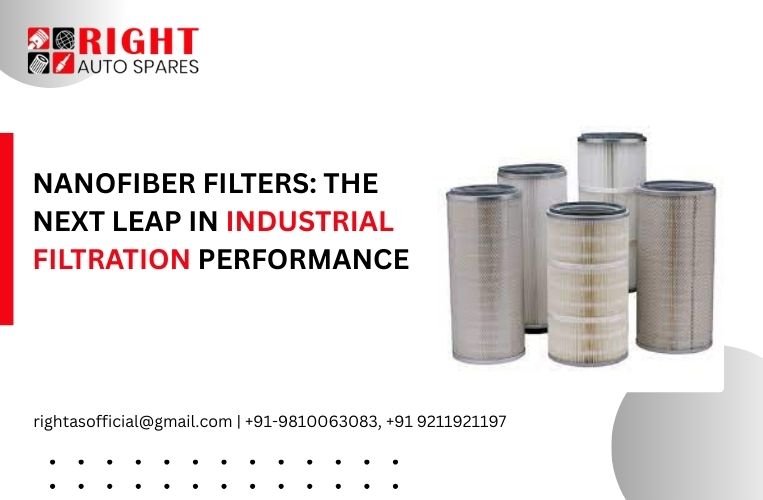




Industrial machinery and automotive sectors face a growing need for effective filtration technologies. Dust, dirt, moisture, and other small particulates have an adverse impact on the performance and safety of engines and machinery. Industries have benefited from filter media made of cellulose and synthetic fibers, but industrial and automotive filtration are set to experience a paradigm shift with the introduction of nanofiber filters—which represent a breakthrough technology.
At Right Auto, a reliable industrial partner and an Indian automobile spare parts provider, we understand that advanced technology drives better performance. That is why we believe that exploring nanofiber filters is important for companies looking for dependability, longevity, and eco-friendliness.
What Are Nanofiber Filters?
Nanofiber filters are filtration systems that utilize extremely thin fibers measured in nanometers (which can be approximately 100 times thinner than a human hair) to eliminate contaminants. Nanofiber filters are unlike traditional filter media because they create a highly efficient web-like structure with microscopic pores.
Filters of this type are able to filter particles that are extremely tiny—even submicron-level particles—and maintain optimal airflow. This type of filter is the only type that provides a longer service life coupled with superior filtration efficiency and energy performance when compared to traditional filters.
The Advantages of Nanofiber Filters in Industrial Applications
Industrial and automotive filtration systems are fundamentally important in achieving overall system protection. Imagine the filtration systems that safeguard engines of heavy trucks and buses, or those that work tirelessly to provide clean, breathable air in factories. Their impact on our well-being and the efficiency of protective filtration solutions is immense. Here is why nanofiber filters are the best choice:
1. Superior Filtration Performance
Nanofiber filters are effective in filtering dust, soot, harmful contaminants, and other particles. As a result, they foster the smooth operation of equipment and engines by filtering even those particles with a size of 0.3 microns.
2. Prolonged Use Span
Uneven particle distribution causes traditional filters to clog quickly. Unlike these filters, nanofiber ones retain particles on their surface. This surface retention means the particles do not embed deeply into the filter media. Therefore, rates of clogging, replacement, and maintenance drop significantly.
3. Reduction in Energy Cost
Nanofiber filters do not restrict airflow. As a result, less energy is required to push air in the system, leading to greater energy savings. Similarly, industrial systems witness a drop in electricity costs.
4. Environmental Sustainability
Nanofiber technology supports sustainability goals by extending filter life, reducing waste, and lowering carbon emissions through energy savings.
5. Versatility Across Applications
From heavy-duty trucks, buses, and construction machinery to manufacturing plants and power generation facilities, nanofiber filters are being adopted across multiple industries.
Applications of Nanofiber Filters in Industrial and Automotive Sectors
Right Auto understands the filtration challenges faced by our customers. Some of the important use cases of nanofiber filters are:
1. Automobile Engines
In trucks, bicycles, and commercial vehicles, nanofiber air filters improve the fuel system's efficiency and prevent engine wear by filtering more dust and fuel particles. This results in better performance and less fuel use.
2. Heavy Construction Equipment
Loaders, excavators, and other construction equipment used in fragile and dusty regions need constant maintenance and protection. The downtime is reduced significantly with the use of nanofiber filters for reliable engine protection.
3. Industrial Manufacturing
The use of nanofiber filters is essential in manufacturing plants that generate dust, fumes, and other detrimental airborne particles in order to improve air quality and ensure worker safety. Additionally, nanofiber filters protect machinery from such harmful elements.
4. Energy Facilities
The use of nanofiber filters in the gas turbines, compressors, and air intakes is crucial in ensuring their efficiency and in energy savings through the avoidance of costly repairs.
5. HVAC and Air Purification Systems
In both commercial and residential buildings, nanofiber filters are being utilized in air handling units to preserve indoor air quality, which is critical for health.
Nanofiber Filters vs. Traditional Filters
To understand the real value of nanofiber technology, let’s compare it with conventional filters:
Feature | Traditional Filters | Nanofiber Filters |
Filtration Efficiency | Moderate (70–85%) | Very High (up to 99%) |
Particle Size Capture | Limited to larger particles | Captures sub-micron particles |
Service Life | Shorter, prone to clogging | Longer, clogging-resistant |
Airflow Resistance | Higher | Lower, allowing better energy efficiency |
Maintenance Cost | Frequent replacements needed | Reduced frequency, cost-effective |
Environmental Impact | More waste due to replacements | Less waste, eco-friendly |
Clearly, nanofiber filters offer significant benefits in terms of performance, longevity, and sustainability.
The Benefits of Nanofiber Filtration for Every Industrial Sector
The equipment and fuel costs keep on rising, and there is an ever-increasing pressure on the emissions and durability of machinery. Meeting all these challenges with proper equipment is no longer a choice; it is mandatory. For companies with a fleet of vehicles, heavy machinery, or industrial equipment, nanofiber filters ensure the following benefits:
- Less mechanical breakdowns and servicing.
- Improved fuel consumption and reduced operating expenses.
- Better safeguarding of premium machinery and associated equipment.
- Supporting green initiatives.
The Future of Filtration: Innovation with Nanofiber Technology
As nanofiber technology advances, the following exciting possibilities emerge:
Custom Filters: Designs tailored to address the distinct challenges of sectors, ranging from automotive to clean-room industries.
Green Materials: Progress in biodegradable nanofibers may help lessen the impact on the environment.
Smart Filters: The integration of IoT sensors with nanofiber filters might offer instant updates on filter conditions.
Because various sectors require advanced and environmentally friendly filters, nanofiber filters will continue to lead in the industrial filtration innovations.
Right Auto: Your Trusted Partner for Advanced Filtration Solutions
We provide quality automobile spare parts at Right Auto to bolster industrial growth. While technology continues to evolve, our aim is to provide innovative products and trustworthy suppliers that follow international performance criteria.
If you require automobile spare parts such as air and fuel filters, our experts will help you obtain hassle-free and advanced solutions at a reasonable price. With the increase of nanofiber technology, our focus is to keep our clients at the forefront of engine and industrial performance protection.
Conclusion
Nanofiber filters mark a significant advancement in filtration for both industry and automotive sectors. They stand out because they combine remarkable efficiency with operational longevity over an extended period. Their efficiency is coupled with eco-friendly benefits, unlike any other. Several industries are changing for the better, as they improve the reliability of their machinery, reduce maintenance, and help in lowering energy usage.
In an effort to make their operations as efficient as possible and to prolong the working life of their assets, companies are set to gain a lot from nanofiber filters. At Right Auto, we continue to align with such innovations to ensure that our customers benefit from the best spare parts and filtration technologies available today.