
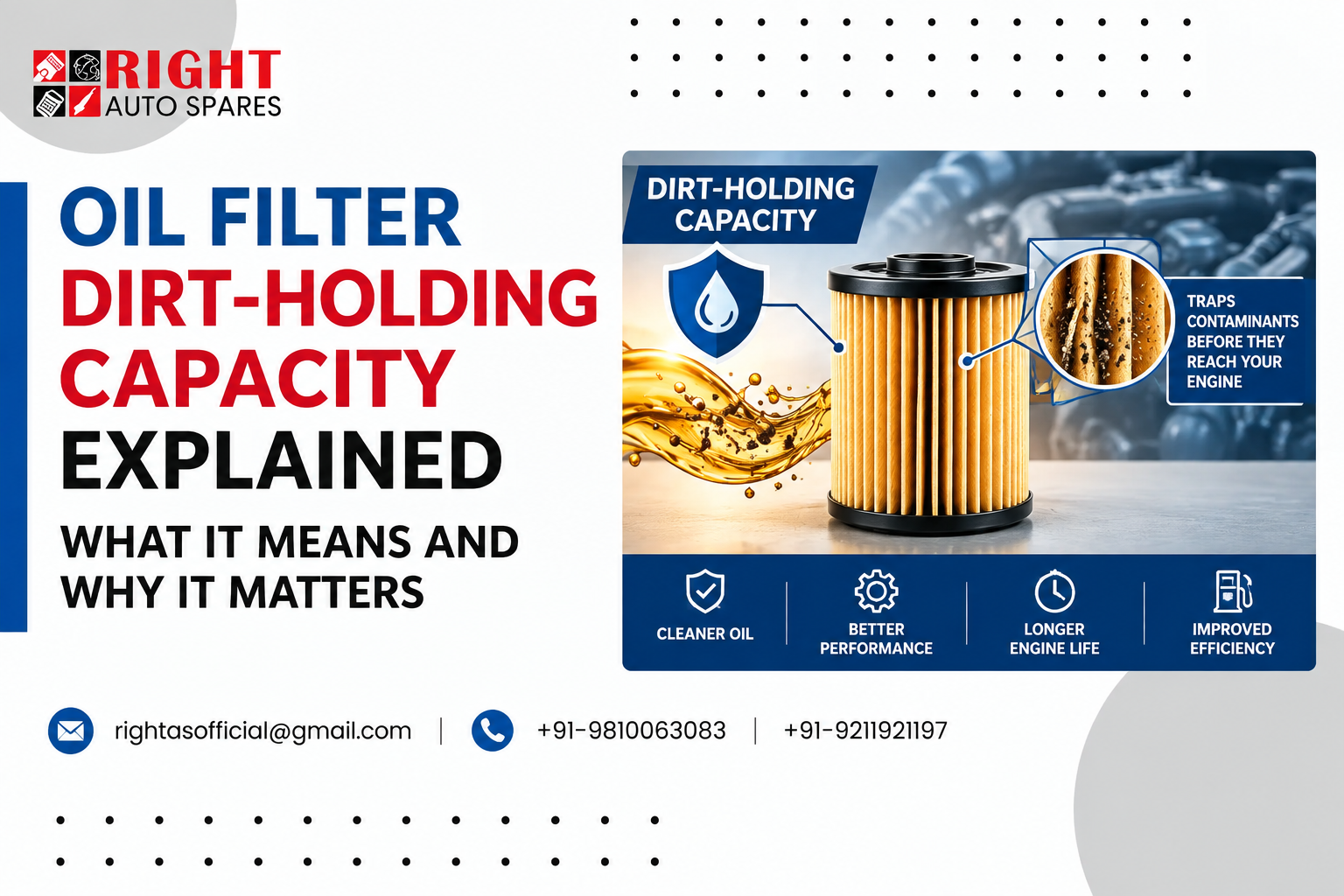

Oil filter dirt-holding capacity is the amount of contaminant a filter can retain before reaching its specified terminal pressure drop. It indicates how much contamination the filter can hold under defined test conditions before restriction becomes excessive.
For vehicle owners, workshops, fleet operators, distributors, and spare-parts buyers, this is an important measure of filter performance. However, capacity should be considered alongside filtration efficiency, oil flow, pressure characteristics, filter construction, application, and the engine manufacturer's requirements.
What Is Oil Filter Dirt-Holding Capacity?
As engine oil circulates, it carries contaminants produced by engine operation and introduced from the surrounding environment. The oil filter captures these particles within its filter media.
As contamination accumulates, resistance to oil flow can increase. During standardized testing, contaminants are introduced into the oil circuit while pressure across the filter is monitored. The test ends when the filter reaches its specified terminal pressure drop. The quantity of contaminant retained at that point is used to determine its dirt-holding capacity. ISO 4548-12 specifies a multi-pass test method for full-flow lubricating oil filters used with internal combustion engines.
In simple terms, dirt-holding capacity indicates how much specified contamination a filter can retain before reaching its defined restriction limit.
Why Does Dirt-Holding Capacity Matter?
An oil filter needs to capture contamination throughout its intended service period without becoming excessively restricted.
As the filter loads with particles, differential pressure can rise. Many engine lubrication systems incorporate a bypass mechanism to protect oil circulation if filter restriction becomes excessive. When bypass occurs, oil can pass around the filter element rather than through it.
That makes correct filter selection and timely replacement important. A high dirt-holding capacity can be useful, but it does not by itself determine whether a filter is suitable for an engine.
Dirt-Holding Capacity vs Filtration Efficiency
Dirt-Holding Capacity vs Filtration Efficiency
These measurements answer different questions.
Dirt-holding capacity indicates how much specified contaminant a filter can retain before reaching its defined terminal condition.
Filtration efficiency indicates how effectively a filter removes particles of a specified size under stated test conditions.
Beta ratio is another measure used to describe particle capture performance at a particular particle size. These measurements should not be treated as interchangeable.
| Filter Characteristic | What It Tells You |
|---|---|
| Dirt-Holding Capacity | Amount of specified contaminant retained before the test limit is reached |
| Filtration Efficiency | Percentage of particles captured at a specified size and test condition |
| Beta Ratio | Particle capture relationship at a specified particle size |
| Pressure Drop | Pressure difference across the filter |
| Flow Capacity | Oil flow the filter can accommodate under specified conditions |
A filter with greater capacity is not automatically the most efficient filter. Likewise, a filter with high particle-capture efficiency is not automatically the best choice for every engine.
How Is Oil Filter Dirt-Holding Capacity Tested?
ISO 4548-12 uses a multi-pass test for full-flow lubricating oil filters. The procedure introduces a controlled contaminant into the oil while the filter operates at defined conditions. Particle removal and differential pressure are monitored during the test.
The filter continues collecting contaminants until it reaches the specified terminal differential pressure. Its retained contaminant is then used to establish the test result.
This is important when comparing products because a capacity figure has meaning only when its test method and conditions are understood.
Why Test Conditions Matter When Comparing Filters
Suppose one filter is advertised with a higher dirt-holding capacity than another. It would be tempting to declare the first filter better.
That conclusion may be premature.
Measured capacity can vary with factors including:
Test contaminant
Oil viscosity
Flow rate
Filter media
Filter element design
Terminal pressure drop
Test procedure
Technical filtration guidance notes that measured dirt capacity can change with flow rate, contaminant characteristics, and the pressure-drop limit used during testing.
For this reason, buyers should compare capacity figures only when the underlying test conditions are reasonably comparable.
What Affects an Oil Filter's Dirt-Holding Capacity?
Filter Media
The media provides the structure through which oil passes and where contaminants are retained. Its construction, permeability, and available filtration area influence both particle retention and pressure characteristics.
Different manufacturers use different media technologies, so capacity figures should be evaluated alongside the complete product specification.
Filter Element Area
Pleated filter media increases the available filtration area within a compact element. A greater usable media area can support higher contaminant capacity, although the final result also depends on media construction and filter design.
Contaminant Characteristics
Particle size, concentration, shape, and composition affect how contamination accumulates in the media. Standardized testing therefore uses controlled contaminant conditions.
Oil Viscosity
Oil viscosity affects resistance to flow. Cold oil is generally more viscous than oil at normal operating temperature, which can increase pressure drop through the filter.
Flow Rate
Higher flow can increase pressure drop across a filter. Because flow conditions affect test results, they should be considered when comparing published capacity figures.
Terminal Pressure Drop
The reported capacity is tied to the pressure-drop limit established by the test. Two capacity figures measured against different terminal conditions may therefore not provide a fair comparison.
Does Higher Dirt-Holding Capacity Mean Longer Filter Life?
Not necessarily.
Greater contaminant capacity can support longer operation under comparable conditions, but actual service life depends on the application and contamination load.
Important variables include:
Engine condition
Oil condition
Contaminant generation
Operating environment
Engine load
Oil viscosity
Flow conditions
Maintenance practices
Manufacturer's service interval
A vehicle operating in a clean environment and one working continuously in heavy dust can place very different demands on their filters.
For maintenance decisions, use the equipment manufacturer's recommended service interval and any applicable severe-duty guidance rather than estimating replacement intervals from capacity alone.
What Happens When an Oil Filter Becomes Loaded?
As contamination accumulates, pressure differences across the filter can rise. If restriction reaches the point where maintaining oil circulation through the element becomes difficult, the lubrication system's bypass mechanism may open, depending on the engine design.
The bypass function protects oil circulation. It does not mean the filter can safely remain in service indefinitely.
A heavily loaded filter should therefore be replaced according to the applicable maintenance requirements.
Is Dirt-Holding Capacity More Important Than Filtration Efficiency?
Neither measurement should be considered in isolation.
A suitable oil filter needs an appropriate balance of:
Particle capture
Contaminant capacity
Oil flow
Pressure characteristics
Structural strength
Temperature compatibility
Chemical compatibility
Correct fitment
The engine manufacturer determines the requirements for the application. A filter that performs well in one engine may not be appropriate for another.
What Does Micron Rating Have to Do With Dirt-Holding Capacity?
Micron size refers to particle size. Dirt-holding capacity refers to how much specified contaminant the filter retains before reaching its test limit.
They are therefore different measurements.
A filter advertised as "10 micron" does not automatically have greater dirt-holding capacity than a filter advertised at "20 micron." Particle-capture efficiency at the stated size also matters.
Beta ratio provides additional context because two filters with the same stated particle size can have different capture performance.
When comparing oil filters, look beyond a single micron figure.
Does a Bigger Oil Filter Have Greater Dirt-Holding Capacity?
A larger filter element can provide more media area, which may support greater contaminant capacity. However, physical size alone does not determine performance.
Media construction, element design, flow conditions, pressure characteristics, and application requirements also matter.
Never replace an oil filter with a physically larger alternative simply because it appears to offer more capacity. The replacement must be suitable for the specific engine and lubrication system.
How to Compare Oil Filters Properly
For workshops, distributors, and fleet operators, a complete specification provides a much better basis for comparison than a single capacity figure.
| What to Check | Why It Matters |
|---|---|
| OEM Part Number | Identifies the intended application. |
| Engine or Equipment Application | Confirms compatibility. |
| Dirt-Holding Capacity | Indicates contaminant retention under stated test conditions. |
| Filtration Efficiency | Shows particle-capture performance. |
| Beta Ratio | Provides particle-capture information at a specified size. |
| Flow Requirements | Helps assess suitability for the lubrication system. |
| Pressure Characteristics | Relevant to correct system operation. |
| Filter Dimensions | Confirms physical fitment. |
| Thread and Gasket | Ensures correct mounting and sealing. |
| Manufacturer Documentation | Supports verification of technical claims. |
For aftermarket filters, reliable cross-reference information is particularly important. A matching-looking filter is not sufficient evidence of compatibility.
How Should You Choose an Oil Filter for Heavy-Duty Vehicles?
Heavy-duty engines can operate for long hours and under demanding loads, so filter selection should begin with the manufacturer's application requirements.
Before purchasing, verify:
OEM filter part number
Engine model
Vehicle or equipment application
Required service interval
Filter specifications
Flow and pressure requirements
Operating environment
Manufacturer or supplier documentation
For fleet operators, supply consistency also matters. A correct filter that can be sourced reliably helps simplify maintenance planning and inventory control.
Common Mistakes When Buying Oil Filters
Choosing by Physical Size
Similar dimensions do not guarantee identical filtration or pressure characteristics.
Trusting an Unverified Cross-Reference
Use reliable manufacturer or supplier data to confirm an aftermarket equivalent.
Comparing Capacity Figures Without Test Conditions
A capacity number without its test conditions provides limited information.
Buying Solely on Price
A lower unit price does not necessarily represent lower overall maintenance cost.
Assuming a Micron Number Tells the Whole Story
Particle size alone does not describe capacity, efficiency, flow, or overall filter suitability.
Extending Service Intervals Without Evidence
Filter life should follow the equipment manufacturer's maintenance requirements unless documented technical guidance supports a different interval.
How Right Auto Spares Can Help With Oil Filter Sourcing
Right Auto Spares supplies genuine OEM and aftermarket automotive and industrial spare-parts options.
For an oil filter enquiry, buyers should provide the OEM part number, vehicle or equipment details, engine information, quantity, and destination whenever available.
These details make it easier to establish the correct application before comparing available products. For wholesale requirements, buyers should also confirm manufacturer information, technical documentation, packaging, availability, lead time, and applicable commercial terms before placing a larger order.
Final Takeaway
Oil filter dirt-holding capacity tells you how much specified contamination a filter can retain before reaching its defined pressure-drop limit. It is useful for comparing filter performance, but it is only one part of the selection process.
For a reliable choice, verify the OEM part number, application, filtration efficiency, dirt-holding capacity, oil flow, pressure characteristics, fitment, and manufacturer documentation. This gives workshops, fleet operators, distributors, and importers a sounder basis for selecting an oil filter.
Right Auto Spares can support genuine OEM and aftermarket oil filter sourcing based on the specific part number and application.
Frequently Asked Questions
What is dirt-holding capacity in an oil filter?
Dirt-holding capacity is the amount of specified contaminant an oil filter can retain before reaching its defined terminal pressure-drop condition during testing. It indicates contaminant-retention capability under the stated test conditions.
Is higher oil filter dirt-holding capacity better?
Higher capacity can be useful when comparing otherwise similar filters under comparable test conditions. It should still be assessed alongside filtration efficiency, oil flow, pressure characteristics, application, and manufacturer requirements.
How is oil filter dirt-holding capacity measured?
ISO 4548-12 specifies a multi-pass test for full-flow lubricating oil filters. The procedure measures contaminant capacity, particle removal characteristics, and differential pressure under defined conditions.
What is the difference between dirt-holding capacity and filtration efficiency?
Dirt-holding capacity measures how much specified contaminant a filter retains before reaching its defined test limit. Filtration efficiency measures how effectively the filter captures particles of a specified size. They are separate performance characteristics.
Does a higher micron rating mean better dirt-holding capacity?
No. Micron size and dirt-holding capacity measure different characteristics. A proper comparison should consider particle-capture efficiency, capacity, flow, pressure characteristics, and the intended application.
How do I know which oil filter is right for my engine?
Start with the OEM part number and exact engine or equipment application. Then verify the replacement manufacturer's cross-reference and technical specifications. Right Auto Spares can help assess an oil filter sourcing requirement when the relevant part number and application details are provided.